What is the "Should I Buy This?" test?
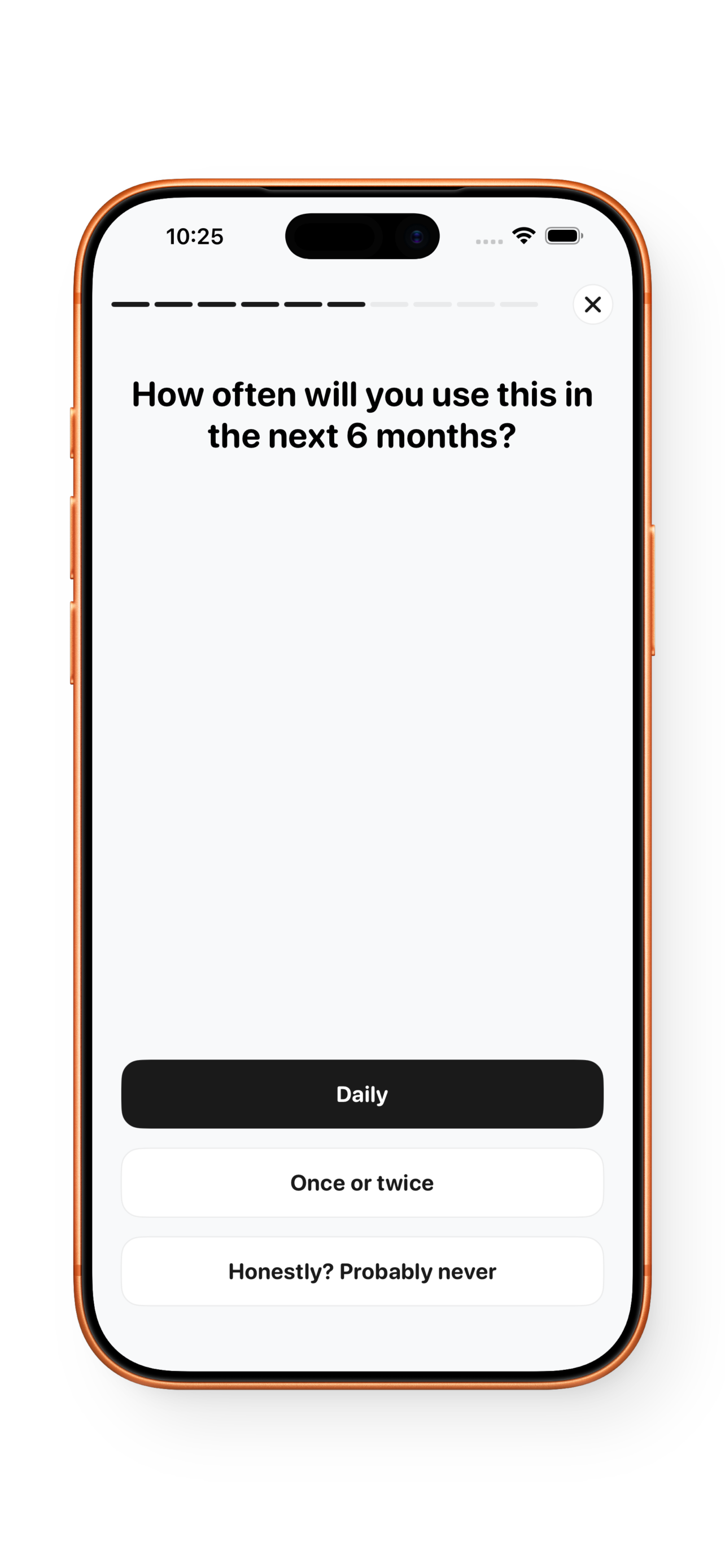
The Should I Buy This? quiz is a free, 60-second impulse-purchase test designed to interrupt a moment that almost every modern consumer knows: your thumb is hovering over the buy button, your heart is racing a little, and some quiet part of you already suspects you'll regret this tomorrow. The quiz asks you five short, deliberately uncomfortable questions about the purchase, your history with it, and your current emotional state — and returns a single impulse score from 1 to 10 with a concrete recommendation.
It is not a magical formula. It's a structured pause. And a structured pause, repeatedly, is the single most consistent intervention the research on impulse buying has found. The goal isn't to shame you into never buying things again — it's to help you tell the difference between a purchase you chose and a purchase that an algorithm, an ad, or a bad mood chose for you.
How the impulse buy quiz works
Each of the five questions maps to a weighted value between 1 (low impulse risk) and 10 (very high impulse risk). The score you see at the end is the average across all your answers, displayed with one decimal and animated so you can feel the needle land.
The five questions cover the five factors most strongly linked to post-purchase regret:
- Motivation. Is this a need, a want, or a trigger reaction to something you saw online?
- Duration of desire. Is this a long-considered purchase, or a 12-minute-old craving?
- Redundancy. Do you already own something that does the job?
- Realistic usage. How often will you actually use it once the novelty fades?
- Emotional state. Are you calm, bored, stressed, or in full FOMO mode?
Your recommendation is then mapped to one of five verdicts:
- 1.0 – 2.9 · Green light. This looks like a thought-through purchase. Go ahead.
- 3.0 – 4.9 · Amber. Probably fine. Sleep on it for 24 hours and decide tomorrow.
- 5.0 – 6.9 · Cool off. Wait at least 7 days. Most of the urge will be gone.
- 7.0 – 8.4 · Warning. Classic impulse buy. Wait 30 days before revisiting.
- 8.5 – 10.0 · Don't buy this. This pattern looks like compulsive buying. Walk away.
What impulse buying actually costs you
Impulse buying isn't a small leak. On average, US adults spend over $314 per month on unplanned purchases, and roughly 80% of impulse buyers report regret after the fact. Multiply that over a year and it's the equivalent of a holiday, a debt payoff, or an emergency fund — spent on items most people can't even remember 30 days later.
The hidden cost is even bigger than the dollar figure. Every impulse purchase trains your brain to chase the small dopamine spike of the checkout moment, not the long-term satisfaction of owning something useful. Over time, the spike has to get bigger to feel the same — which is exactly the feedback loop that TikTok Shop, Instagram ads, and one-click checkout are engineered to exploit.
The 7 warning signs of an impulse buy
If more than two of these apply, your score on the quiz is probably going to be high:
- You'd never heard of this product an hour ago.
- You discovered it on a social feed (TikTok, Instagram, YouTube, Reddit).
- There's a timer, a "limited drop," or a countdown next to the price.
- You're telling yourself you "deserve" this, or that it'll "fix" a bad mood.
- You already own something that does roughly the same thing.
- You can't picture yourself using it in a specific, concrete situation.
- You're hiding the purchase — from your partner, your budget, or yourself.
The last one is the most important. Concealed spending is one of the strongest signals that behaviour has crossed from "impulsive" into "compulsive."
Compulsive buying disorder (oniomania): when shopping becomes a problem
Most of us impulse-buy occasionally. But for an estimated 5% of adults in Western countries, shopping crosses a line into compulsive buying behaviour — also called oniomania or shopping addiction. It's characterised by:
- A persistent, intrusive urge to shop that's hard to control.
- Shopping to regulate difficult emotions (stress, loneliness, anger, sadness).
- Financial, relational, or professional harm caused by buying.
- Hidden purchases, hidden deliveries, hidden debt.
- Brief relief or euphoria during a purchase, followed by guilt, shame, or a crash.
If any of that reads like a diary entry, please know two things: first, you're far from alone, and second, this is a recognised behavioural pattern that responds well to therapy — particularly cognitive-behavioural therapy (CBT). A tool like this quiz, or an app like CutCut, is a useful companion; it is not a substitute for a licensed therapist if spending is harming your life.
How to stop impulse buying (what actually works)
The research on self-control and consumer behaviour is remarkably consistent: the strategies that actually work are boring, structural, and don't rely on willpower.
- Add friction. Log out of stored-card checkouts. Remove shopping apps from your home screen. The extra 30 seconds of typing is often the entire battle.
- Mandatory cooling-off periods. Never buy anything over a set threshold (say, €50) on the day you first see it. This is the single most effective intervention in the behavioural literature — and the core mechanism behind CutCut.
- Name the trigger. Before you buy, answer: "What am I feeling, and what do I think this purchase will fix?" Nine times out of ten, the real problem has nothing to do with the item.
- Unfollow the feed. If a creator, subreddit, or ad platform is triggering 80% of your unplanned purchases, that's a source problem, not a willpower problem. Mute or unfollow.
- Track what you didn't buy. Every purchase you passed on is real money saved. Seeing that number grow rewires the reward circuit over time. CutCut's dashboard is built around this.
Go deeper: CutCut's Circuit Breaker
This quiz is a snapshot. If it landed hard — if you realised you've been making a lot of these decisions on autopilot — CutCut is the next step. It's an iOS app that turns every online purchase into a deliberate choice:
- Paste any link. CutCut pulls the item, price, and image automatically.
- A personalised cooling-off period starts — bigger prices, longer waits.
- Premium members unlock the Circuit Breaker: an in-app interrogation that asks the uncomfortable questions before an item even enters your waitlist. Think of it as this quiz, baked into every single purchase you make.
- At the end of the wait, you get a Decision Time screen: buy, or pass. No algorithm, just you.
It's free to download, premium is €1.29/month, and a lifetime unlock is €9.99 one-time. Most users earn that back with a single prevented impulse buy.